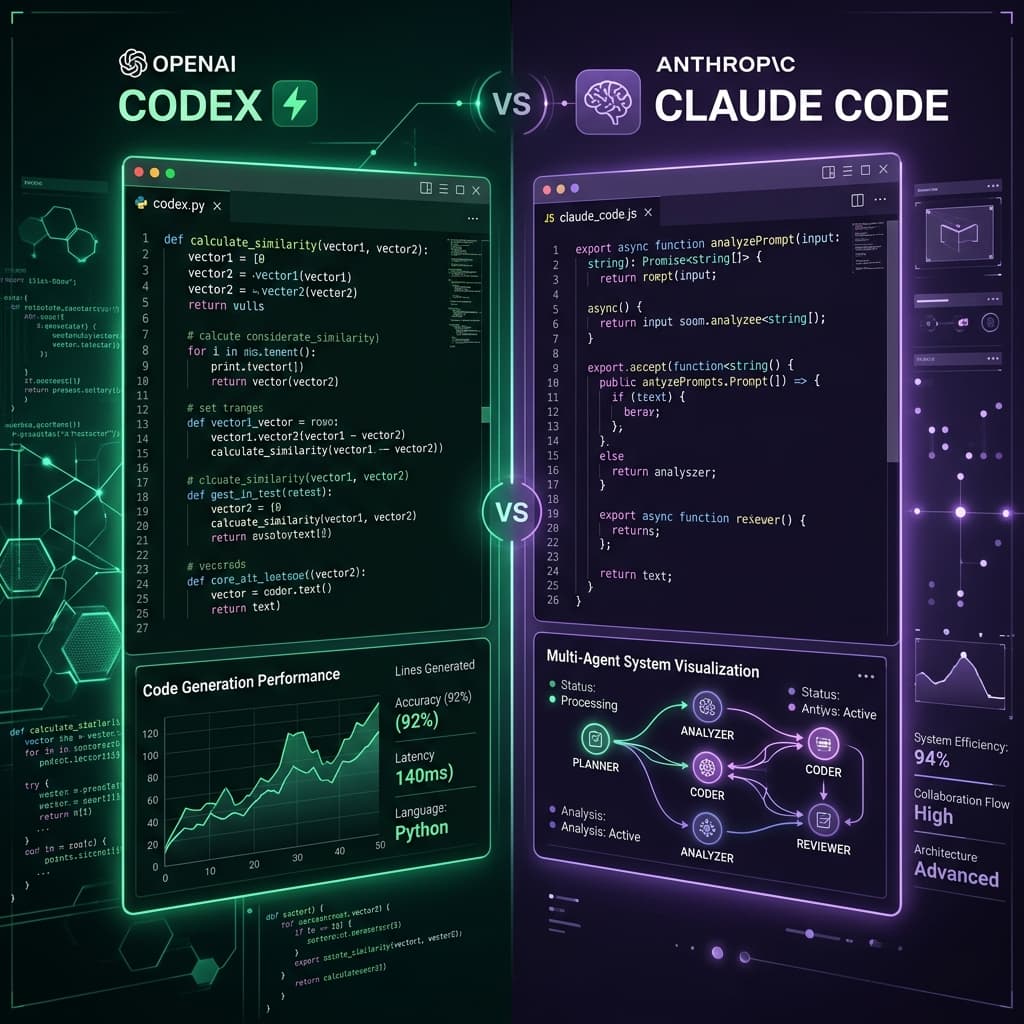
Comparing the two titans of AI-assisted development in 2026.
In the rapidly evolving landscape of AI-assisted development, two platforms have emerged as the primary contenders for the modern developer's toolkit: OpenAI Codex and Anthropic Claude Code. Choosing between them isn't just about picking an LLM; it's about choosing a development philosophy.
The right option depends entirely on your workflow, budget, and level of involvement in the development process. In many practical scenarios, Codex and Claude Code deliver similar functional results, but the path they take to get there—and the cost of that journey—varies significantly.

OpenAI Codex
- ✓Value King: Significantly lower price point for comparable functional output.
- ✓Autonomous: Excels at TDD and working independently in unfamiliar codebases.
- ✓Structured: Reliable code generation with minimal human intervention required.

Claude Code
- ✓Opinionated: Perfect for maintaining specific architectural design patterns.
- ✓Advanced Tooling: Leverages skills and sub-agents for complex workflows.
- ✓Integrated: Fits seamlessly into mature engineering environments and processes.
The Case for OpenAI Codex: Value and Autonomy
If cost is your primary concern, Codex is usually the stronger choice. For developers or teams looking for maximum value without overspending, Codex often provides a better return on investment. It’s functionally equivalent in most day-to-day coding tasks but wins decisively on price.
Where Codex truly shines is in its autonomous coding methodology. If you are working in a codebase that you don't necessarily understand, Codex is the ideal partner. Its test-driven development (TDD) approach allows it to write code and verify it independently. If you don't want to jump in, don't need to guide every decision, and have few opinions about the specific implementation details, Codex is the clear winner. It takes the lead and delivers structured, reliable results with minimal hand-holding.
Ready to Optimize Your
AI Development Workflow?
We help engineering teams select and implement the right AI agents to maximize productivity while minimizing API costs.
The Case for Anthropic Claude Code: Precision and Integration
Why would you pay the extra money for Claude Code? The answer lies in your specific tech stack and architectural requirements. Claude Code becomes the stronger option when customization, architecture consistency, and workflow integration matter more than raw cost efficiency.
If you have an established tech stack, specific design patterns you like to use, and a process that must be followed, Claude Code's Skills and Sub-Agents are game-changers. Developers who are opinionated about their code—trying to fit things into pre-existing infrastructure or organizational standards—will find Anthropic's approach far superior.
Features such as customizable workflows make it particularly effective for integrating into mature engineering environments where processes and standards must be maintained consistently across projects. While Codex handles the implementation, Claude Code handles the integration. This is why many experienced developers continue using Claude Code despite the price tag: it aligns more deeply with long-term development practices and organizational needs.
| Feature | OpenAI Codex | Claude Code |
|---|---|---|
| Cost Efficiency | High (Best Value) | Moderate to Low |
| Architectural Control | Standard | Superior (Skills/Agents) |
| Unfamiliar Codebases | Excellent (Autonomous) | Good |
| Workflow Integration | Moderate | Deeply Customizable |
The Verdict: Choosing Your Champion
The decision process for most projects is straightforward: if cost is the primary issue, choose Codex. It is functionally equivalent for the majority of coding tasks and wins easily on price. If you want a "set it and forget it" autonomous agent that handles the implementation while you focus on high-level strategy, Codex remains the winner.
However, if you are trying to fit code into an existing organization, an opinionated tech stack, or a specific process, Claude Code is the clear winner. The ability to create custom plugins, skills, and sub-agents allows it to overcome the benefits of Codex's independent methodology by ensuring the output fits perfectly into your infrastructure.
Summary: Codex is ideal for affordability and autonomous coding, while Claude Code is better suited for structured, opinionated development environments where precision and integration matter most.
Master the
AI Stack
Whether you choose Codex or Claude, our experts can help you architect the perfect AI-driven development pipeline for your specific business needs.